Kalulla: A Clean Script Handwritten Font for Modern Websites
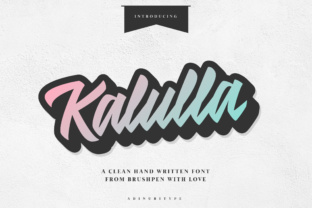
Two weeks ago, I was finalizing the hero section of a boutique coaching website — soft pastel background, minimalist layout, and a headline that needed to feel warm but not cutesy, personal but still polished. I tried three script fonts before landing on Kalulla. Instantly, it clicked: this Script Handwritten font carries the organic flow of a brush pen, yet its digital precision gives it crisp legibility at 48px on desktop and even 36px on mobile. No wobble, no unintended thinning, no awkward joins — just quiet elegance.
Kalulla for Wedding Invitations and Elegant Branding
I’ve used Kalulla across two recent client projects where tone mattered more than trend: a wedding planning portfolio site and a small-batch ceramic studio’s online shop. In both, Kalulla became the voice behind “handmade with care” — not in a literal, arts-and-crafts way, but through refined rhythm and balanced spacing. As a Script Handwritten font, it avoids the overused flourishes of many display fonts. Instead, its subtle entry and exit strokes feel intentional, like handwriting you’d trust on a custom letterhead or engraved business card. That same nuance translates beautifully to digital branding: think hero subheads (“Your first session starts with listening”), testimonial quotes, or even the “About” section title — all places where personality meets professionalism.
Kalulla for Landing Page Headlines and Campaign Banners
For a limited-time course launch page, I tested Kalulla as the primary headline font against a muted gradient banner. It held up remarkably well — especially when paired with a clean sans serif (Inter, set at 18px/1.6 line height) for body copy. Because Kalulla is a Script Handwritten font designed with digital use in mind, it doesn’t fade or blur on high-DPI screens. I checked it at 320px width: still readable at 32px weight. That’s rare for script fonts. On dark backgrounds? I lightened the color slightly (not pure white) and added subtle letter-spacing (+0.5px) — no shadow needed. For banners with image overlays, I kept Kalulla to short phrases only (“Join the Circle”, “New Workshop Live”) — never full sentences. Its strength lies in evoking mood, not scanning speed.
Kalulla for Portfolio Websites and Creative Brand Kits
A creative director friend asked me to review her brand kit assets before handing them off to freelance designers. She’d chosen Kalulla as her signature script — and rightly so. As a Fonts choice for portfolios and digital brand kits, Kalulla bridges craft and clarity. It works in SVG logos (clean vector paths), social media graphics (crisp at 1080px width), and email headers (loads fast, renders reliably). What sealed it for her was the consistency across weights: though Kalulla is a single-style Script Handwritten font, its natural contrast — thicker downstrokes, delicate upstrokes — creates visual hierarchy without needing bold variants. That means fewer font files, faster load times, and simpler CSS declarations.
Kalulla for Business Cards and Letterheads in Digital Layouts
Even in fully digital contexts — like downloadable PDF brand guidelines or Figma design systems — Kalulla shines as the go-to Fonts option for stationery-inspired elements. I recently built a Notion-based client onboarding kit where “Welcome” headers used Kalulla, while all instructions stayed in a neutral sans serif. The contrast felt human, not hierarchical. Same logic applies to digital letterheads: using Kalulla for the sender’s name or tagline adds warmth without sacrificing polish. Just avoid tight tracking (< 0) — this Script Handwritten font needs room to breathe, especially at smaller sizes (never below 20px for print-equivalent PDFs).
Kalulla for Blog Headers and Editorial Web Design
When redesigning a mindfulness blog, I reserved Kalulla strictly for post titles and category labels — never body text, pull quotes, or navigation. Why? Because as a Script Handwritten font, its charm lives in brevity. A long paragraph in Kalulla would fatigue readers; a 3–5 word title invites pause and presence. I paired it with a gentle serif (Cormorant Garamond, regular weight) for article intros — a classic editorial pairing that feels grounded but not stiff. Bonus: Kalulla includes standard OpenType features (ligatures, alternate characters) that subtly enhance rhythm in headlines. Enable them in CSS via font-variant-ligatures: common-ligatures; — small detail, big polish.
Kalulla for Online Store Banners and Product Landing Pages
For a handmade soap brand’s new product landing page, Kalulla anchored the top banner: “Lavender & Oat Milk — Hand-Poured Since 2020”. It worked because the phrase was short, meaningful, and aligned with the brand’s tactile identity. As a Fonts choice here, Kalulla didn’t compete with product photography — it complemented it. I made sure the font file was served as WOFF2 (lightweight, widely supported) and confirmed commercial licensing covered web embedding and e-commerce use. No surprises. No legal friction. Just clean, confident typography that says “crafted” without saying it out loud.
What to Check Before Using Kalulla in Your Next Project
- Webfont support: Confirm WOFF2 and variable font options are included — critical for performance
- Licensing scope: Verify usage covers client work, SaaS dashboards, Shopify themes, and digital ad creatives
- Character coverage: Check Latin-1 support at minimum — essential for English, French, Spanish, and German sites
- Pairing guidance: Use a highly legible sans serif (like Inter, Manrope, or Poppins) for UI text and body copy
- Responsive testing: Preview Kalulla on iOS Safari and Android Chrome — some script fonts render inconsistently
If you’re choosing Kalulla for your next website, portfolio, or digital brand system — you’re not just picking a Script Handwritten font. You’re selecting a voice that’s both approachable and assured, handmade but digitally precise, elegant without being distant. It’s one of those rare Fonts that feels like a collaboration, not a decoration.